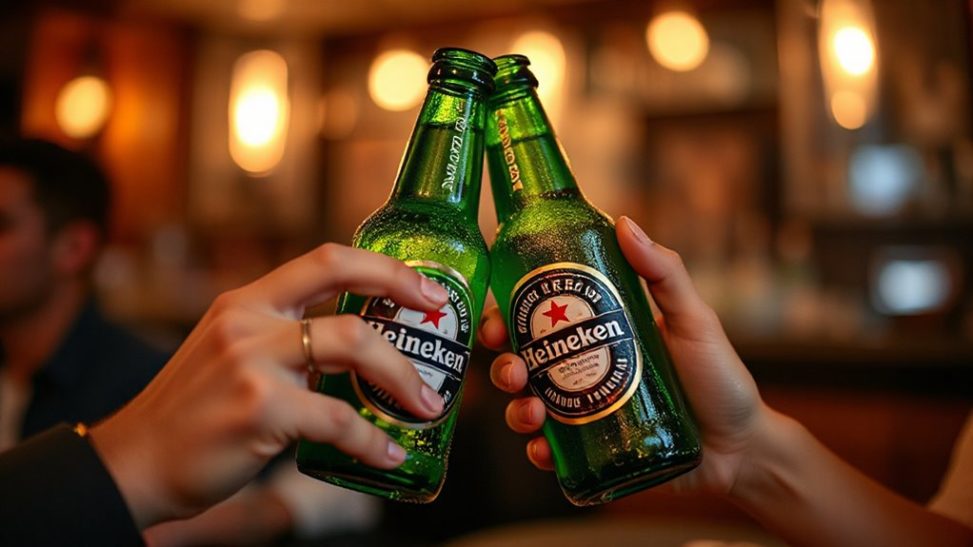
Heineken Beer started in 1864 when Gerard Adriaan Heineken bought a struggling Amsterdam brewery and turned it into a global powerhouse through obsessive quality control and smart science. The brand’s secret weapon? A proprietary yeast strain developed in 1886 that gives the lager its signature taste with subtle banana notes. Within decades, Heineken dominated French imports and earned international awards. Today the company operates 165 breweries across 70 countries, but the formula hasn’t changed—same yeast, same standards, same green bottle that’s been around since the beginning.
Key Takeaways
- Heineken was founded in 1864 when Gerard Adriaan Heineken purchased De Hooiberg brewery in Amsterdam, officially launching in 1873.
- The beer uses proprietary A-Yeast developed in 1886, contributing distinctive flavor with subtle banana notes that differentiates the product.
- Heineken adopted Bavarian bottom fermentation in 1869, producing clearer beer with better shelf life and establishing quality control laboratories.
- The brand won Medaille D’Or at Paris exposition, becoming France’s largest beer importer within nine years of market entry.
- Heineken operates over 165 breweries across 70+ countries, employing 85,000 people and producing 348 different beers and ciders.
Every green bottle of Heineken you’ve ever cracked open carries the legacy of a 22-year-old Dutch entrepreneur who had the audacity to buy a 272-year-old brewery and transform it into a global powerhouse. Gerard Adriaan Heineken acquired De Hooiberg brewery in Amsterdam on February 15, 1864, when most guys his age were still figuring out their lives. This wasn’t some trendy startup—the original brewery dated back to 1592 and served Amsterdam’s working class.
What made Heineken different? Smart moves and relentless focus on quality. In 1869, the company ditched traditional top fermentation for the bottom fermentation method, a Bavarian technique that produced clearer, purer beer with better shelf life. Then came the real game-changer: A-Yeast, developed in 1886 by Dr. Hartog Elion, a student of Louis Pasteur. This proprietary yeast remains the secret weapon in every Heineken today, giving it that distinctive flavor with subtle banana notes. People with at least one close relationship experience higher life satisfaction, which mirrors how Heineken’s focus on relationships with suppliers and consumers strengthened the brand.
The brand officially launched in 1873 when the brewery became Heineken’s Bierbrouwerij Maatschappij. Two years later, they won the Medaille D’Or at the International Maritime Exposition in Paris. That wasn’t just a trophy—it opened the French market. Within nine years, Heineken was shipping 64,000 hectolitres to France, making them the country’s largest beer importer. A second brewery opened in Rotterdam in 1874, expanding production capacity beyond Amsterdam.
Here’s what matters: Heineken keeps it simple. Barley, hops, water. No additives, no shortcuts. They established the brewing industry’s first quality control laboratory because they actually cared about consistency. This wasn’t marketing fluff—it was operational discipline that scaled. The company’s distinctive five-point star became a recognizable symbol on early labels alongside the signature green color.
Fast forward to today, and Heineken owns over 165 breweries across 70-plus countries with 85,000 employees producing 348 different beers and ciders. The original Amsterdam brewery stopped production in 1975, replaced by a facility in Zoeterwoude. In 1988, they turned the old site into the Heineken Experience Museum, because even beer giants understand heritage sells.
The takeaway? Gerard Adriaan Heineken didn’t revolutionize brewing overnight. He made calculated decisions, invested in innovation, and refused to compromise on quality. That’s how a 22-year-old turned a centuries-old pub into one of the world’s most recognized brands.
Schreibe einen Kommentar